
Coconut Jaggery Paratha: Sweet Stuffed Indian Flatbread
 India
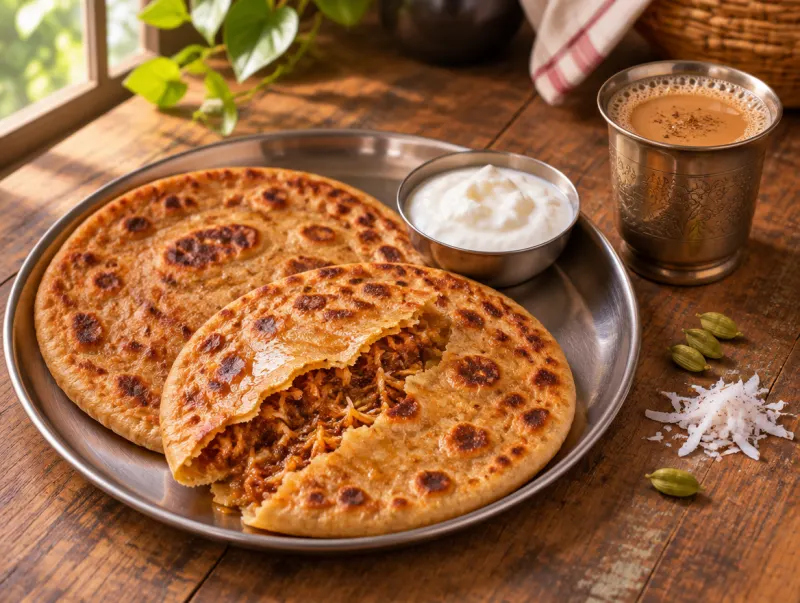
Coconut jaggery paratha is a sweet stuffed flatbread made in Indian homes for breakfast, an after-school snack or a winter treat. A soft whole wheat dough is wrapped around grated coconut mixed with jaggery and cardamom, rolled out and roasted on a hot tawa with ghee until the outside is crisp and blistered.
Prep 45 min · Cook 20 min · Breakfast
Method
- Step 1 of 9
Knead the dough
Mix the whole wheat flour and salt in a bowl, rub in the 2 tsp ghee, then add the lukewarm water a little at a time and knead for 5 to 6 minutes into a soft, smooth dough that does not stick to your fingers. It should be softer than bread dough but not sticky.
You needwhole wheat floursaltgheewaterwhole wheat flourghee - Step 2 of 9 · 20 min
Rest the dough
Cover the dough with a damp cloth or a lid and leave it for 20 minutes. Resting relaxes the gluten so the dough stretches around the filling without tearing.
- Step 3 of 9
Make the filling
In a bowl, mix the grated coconut, grated jaggery, ground cardamom and 1 tbsp whole wheat flour with your fingertips, breaking up any jaggery lumps. It should look like damp, crumbly sand. If it feels wet, add another teaspoon of flour.
You needwhole wheat flourfresh coconutjaggeryground cardamomwhole wheat flour - Step 4 of 9
Divide
Knead the rested dough for a few seconds and divide it into 6 equal balls of about 65 g. Divide the filling into 6 portions too. Keep the dough balls covered while you work so they do not dry out.
- Step 5 of 9
Stuff the paratha
Dust a dough ball with flour and roll it into a 10 cm round. Put one portion of filling in the centre, bring the edges up over it and pinch them firmly together at the top. Twist off any thick knot of excess dough, then flatten the ball gently with your palm.
You needwhole wheat flourwhole wheat flour - Step 6 of 9
Roll it out
Dust the stuffed ball with flour and roll it lightly from the centre outwards into a round about 15 cm across and 3 to 4 mm thick. Use light pressure and turn it often. If filling peeks through, patch it with a pinch of flour.
You needwhole wheat flourwhole wheat flour - Step 7 of 9 · 1 min
Roast the first side
Heat a tawa or heavy frying pan over medium heat. Lay the paratha on it and cook for about 1 minute, until small bubbles appear on top and the underside has light brown spots. Flip it over.
- Step 8 of 9 · 2 min
Roast in ghee
Spread about 1 tsp ghee over the top, flip again and spread ghee on the other side. Press the edges gently with a spatula and cook for 1 to 2 minutes more, flipping once, until both sides are golden and crisp in spots. Lower the heat if the jaggery starts to darken quickly.
You needgheejaggeryghee - Step 9 of 9
Cook the rest and serve
Move the paratha to a plate and repeat with the remaining dough balls and ghee. Let each one cool for a minute before cutting, as the melted jaggery inside is very hot. Serve warm with chai or plain yogurt.
You needgheejaggeryghee
About this dish
As it cooks, the jaggery melts into the coconut and becomes a warm, caramel-like layer inside. Plain gur paratha with jaggery alone is common across North India; adding coconut makes the filling less runny, gives it texture and softens the sweetness, which is why this version is easy for first-timers.
The keys are a soft dough, a filling that is fairly dry, and a medium flame. Too much heat burns the jaggery before the dough is cooked, and a wet filling leaks through the dough. Serve it hot with a cup of chai or a spoon of plain yogurt.
Tips
- Grate the jaggery finely or crush it to a powder. Hard lumps melt unevenly and can burst through the dough.
- Keep the filling on the dry side. The spoon of flour in it absorbs melting jaggery and stops it from leaking onto the pan.
- Cook on medium heat, not high. Jaggery burns fast, and a burnt filling turns bitter.
- If jaggery leaks onto the tawa, wipe it off with a damp cloth before the next paratha so it does not burn and stick.
Variations
- Til gud paratha: swap half the coconut for lightly toasted white sesame seeds, a winter favourite around Makar Sankranti.
- Nutty: add 2 tbsp chopped cashews or almonds to the filling.
- Spiced: add a pinch of nutmeg or a little fennel powder along with the cardamom.
- Vegan: use a neutral oil instead of ghee in the dough and for roasting.
Storing and reheating
Best eaten warm on the day. Wrapped in foil, they keep for 1 day at room temperature or 3 days in the fridge. Reheat on a dry tawa over low heat for a minute on each side.
What to serve with it
- Masala chai
- Plain yogurt
- A small spoon of ghee on top
- A glass of warm milk
Questions
Why does the jaggery leak out of my paratha?
Usually the filling is too wet, the jaggery lumps are too big, or the seam was not sealed. Grate the jaggery finely, add a spoon of flour to the filling, pinch the seam tightly and roll gently with light pressure.
Can I use desiccated coconut instead of fresh?
Yes. Use about 70 g unsweetened desiccated coconut. It is drier than fresh coconut, so the filling holds together less; sprinkle in a teaspoon of water or a little melted ghee if it will not clump.
Can I use sugar instead of jaggery?
You can use brown sugar or plain sugar in the same amount, but the flavour is flatter. Jaggery gives the deep, caramel taste that makes this paratha. Sugar also melts more and leaks more easily, so keep the flour in the filling.
Is coconut jaggery paratha good for kids' lunch boxes?
Yes, it is a popular lunch-box and after-school snack. Let it cool fully before packing so the filling sets, wrap it in foil or a cloth, and pack it the same morning.