
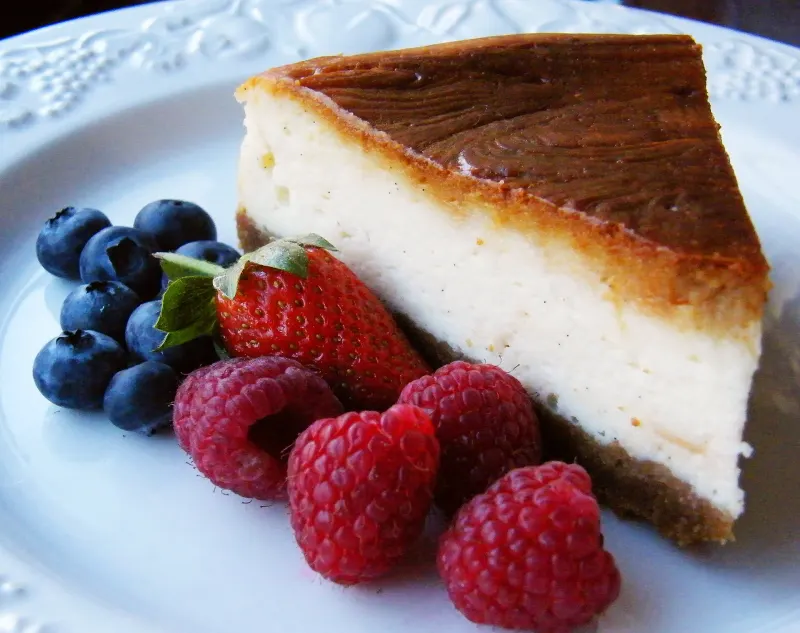
Cheesecake Recipe: Classic Baked New York Cheesecake
 United States
New York cheesecake is the tall, dense, baked cheesecake of American diners and delis: a thin crumb crust under a thick layer of cream cheese, sugar and eggs, baked until just set and chilled overnight. It is richer and heavier than the light, airy cheesecakes of Europe and Japan, and it slices cleanly into neat, creamy wedges.
Prep 30 min · Cook 10 h 25 · Dessert
Method
- Step 1 of 11
Get everything to room temperature
Take the cream cheese, sour cream and eggs out of the fridge about an hour before you start. Soft cream cheese blends smoothly without lumps, so you can mix gently and avoid beating air into the filling.
You needfull-fat cream cheesefull-fat sour creameggs - Step 2 of 11
Heat the oven and wrap the tin
Heat the oven to 160°C (140°C fan). Wrap the outside of a 23 cm springform tin with two layers of wide, heavy foil, covering the base and sides, so no water can seep in during baking.
You needboiling water - Step 3 of 11 · 10 min
Bake the crust
Mix the crushed graham crackers, melted butter and 2 tbsp sugar until it looks like wet sand. Press it firmly and evenly over the base of the tin with the bottom of a glass. Bake until fragrant and lightly golden, then let it cool while you make the filling.
You needgraham crackersunsalted buttersugarsugar - Step 4 of 11
Beat the cream cheese and sugar
Beat the cream cheese on low speed until smooth, scraping the bowl. Add the sugar, flour and salt and beat on low just until creamy and no lumps remain. Keep the speed low throughout.
You needsugarfull-fat cream cheesesugarplain flourfull-fat sour creamsalt - Step 5 of 11
Add the sour cream and flavourings
Mix in the sour cream, vanilla extract and lemon zest on low speed until evenly combined. Scrape down the sides and the bottom of the bowl so no streaks of plain cream cheese are left.
You needfull-fat cream cheesefull-fat sour creamvanilla extractlemon zest - Step 6 of 11
Add the eggs one at a time
Add the eggs one at a time, mixing on low only until each one disappears. Stop as soon as the last egg is in: the filling should be thick, smooth and glossy. Over-mixing at this stage is what causes cracks.
You needeggs - Step 7 of 11
Fill and set up the water bath
Pour the filling over the cooled crust, smooth the top and tap the tin on the counter to burst any bubbles. Set it in a large roasting tin, place it in the oven and pour in boiling water to come about 2.5 cm up the foil.
You needboiling water - Step 8 of 11 · 1 h 15
Bake low and slow
Bake until the edges are set and lightly puffed and the centre still wobbles like set jelly when you nudge the tin. The top should stay pale, with only a faint golden edge.
- Step 9 of 11 · 1 h
Cool in the oven
Turn off the oven, prop the door open a few centimetres with a wooden spoon and leave the cheesecake inside. The gentle drop in temperature helps stop the surface from cracking.
- Step 10 of 11 · 8 h
Chill overnight
Lift the cheesecake out of the water bath, peel off the foil and run a thin knife around the edge. Let it cool to room temperature, then refrigerate, uncovered at first and then loosely covered, until firm.
You needboiling water - Step 11 of 11
Slice and serve
Release the springform ring. Slice with a long knife dipped in hot water and wiped dry between each cut for clean wedges. Serve plain or with fruit, berry sauce or cranberry sauce on top.
You needboiling water
About this dish
This version adds sour cream for a gentle tang and a silky texture, plus a little flour so the filling holds together when cut. The cake bakes low and slow in a water bath, then cools in the switched-off oven. That slow heat is what keeps the top pale and smooth and the middle creamy instead of cracked or rubbery.
Everything should be at room temperature before you start, and the filling is mixed slowly so you do not beat in air. Most of the time here is waiting: the cheesecake needs a full night in the fridge to firm up and taste its best, so it is an ideal make-ahead dessert for a party or holiday table.
Tips
- Use full-fat block cream cheese. Spreadable tub cream cheese and low-fat versions are softer and can leave the filling loose.
- Mix on low speed from start to finish. Air beaten into the filling makes the cheesecake rise in the oven and then sink and crack.
- Do not wait for the centre to firm up in the oven. It should still wobble when you take it out; it sets fully as it chills.
- If the top cracks anyway, cover it with sour cream sweetened with a little sugar, or a fruit topping. It will taste just as good.
- A dark tin bakes faster at the edges. Start checking a little earlier if yours is dark or non-stick.
Variations
- Digestive biscuit crust: in the UK and much of Europe, crushed digestives replace graham crackers with the same weight.
- Lemon cheesecake: use the zest of a whole lemon and 1 tbsp lemon juice in the filling.
- Berry topping: simmer 300 g mixed berries with 50 g sugar until jammy, cool, and spoon over the chilled cake.
- Without sour cream: replace it with the same weight of full-fat Greek yogurt or double cream; the texture is slightly lighter.
Storing and reheating
Keep the cheesecake covered in the fridge for up to 5 days. It freezes well: freeze whole or in slices on a tray until firm, then wrap tightly and freeze for up to 2 months. Thaw overnight in the fridge, still wrapped.
What to serve with it
- Fresh strawberries or a berry sauce
- Cherry or blueberry topping
- A cup of black coffee
Questions
Why did my cheesecake crack?
Cracks usually come from beating too much air into the filling, baking too hot or too long, or cooling it too fast. Mix on low, bake in a water bath until the centre still wobbles, and let it cool slowly in the switched-off oven.
Do I need a water bath for cheesecake?
It is not strictly required, but it gives the most even, gentle heat. Without one, the cheesecake tends to brown on top, turn drier at the edges and crack more easily. Wrapping the tin well in foil keeps the crust dry.
How do I know when cheesecake is done?
The edges should be set and slightly puffed, while a circle in the middle about 8 to 10 cm wide still jiggles when you gently shake the tin. If the whole cake is firm in the oven, it is overbaked.
Can I make cheesecake without sour cream?
Yes. Use the same weight of full-fat Greek yogurt or double cream, or simply leave it out and add one more egg yolk. Sour cream adds tang and silkiness, but the cake still sets without it.
How long does cheesecake need to chill?
At least 8 hours, ideally overnight. The filling keeps setting as it cools, and a properly chilled cheesecake slices cleanly and tastes creamier and less eggy than one served warm.