

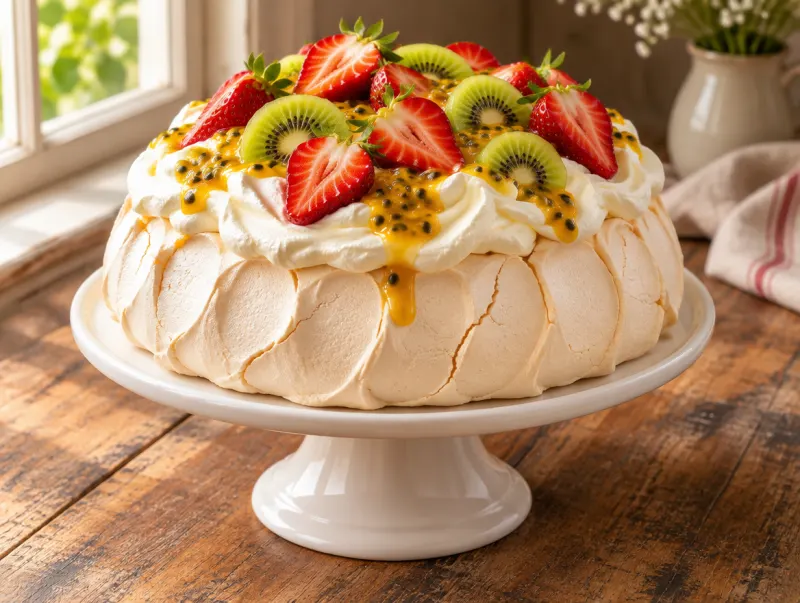
Pavlova Recipe: Crisp Shell, Marshmallow Centre
 Australia
Pavlova is a large baked meringue with a thin crisp crust and a soft, marshmallow-like middle, piled with whipped cream and fresh fruit. It is the dessert of summer and Christmas tables in Australia and New Zealand, and both countries claim it as their own. It is named after the Russian ballerina Anna Pavlova, and at home it is usually just called a pav.
Prep 30 min · Cook 3 h 30 · Dessert
Method
- Step 1 of 10
Heat the oven and mark the tray
Heat the oven to 150°C (130°C fan). Draw a 20 cm circle on a sheet of baking paper, turn the paper over so the pencil line is underneath, and lay it on a flat baking tray. Wipe the mixing bowl and whisk with a paper towel so there is no trace of grease on them.
- Step 2 of 10
Whip the egg whites
Put the egg whites in the clean bowl, making sure no yolk has slipped in. Whisk with an electric mixer on medium speed until they are white and foamy and hold soft peaks that droop over when you lift the whisk.
You needegg whites - Step 3 of 10 · 10 min
Add the sugar slowly
With the mixer on high, add the caster sugar one tablespoon at a time, waiting a few seconds between spoonfuls. Keep whisking for 8 to 10 minutes in total, until the meringue is very thick and glossy. Rub a little between your fingers: it should feel smooth. If it is gritty, keep whisking.
You needcaster sugar - Step 4 of 10
Fold in cornflour, vinegar and vanilla
Sift the cornflour over the meringue, then add the white vinegar and 1 teaspoon of vanilla extract. Fold them in gently with a large spatula, using as few strokes as you can, just until no streaks remain.
You needegg whitescornflourwhite vinegarvanilla extractvanilla extract - Step 5 of 10
Shape the pavlova
Dab a little meringue under each corner of the baking paper to hold it down. Pile the meringue into the centre of the circle and spread it to the line, keeping it about 7 cm high. Smooth the top flat, then sweep the spatula up the sides to make straight walls with light ridges.
- Step 6 of 10 · 1 h 30
Bake low and slow
Put the tray on the lower-middle shelf and at once turn the oven down to 120°C (100°C fan). Bake for 1 hour 30 minutes without opening the door. The pavlova is done when the outside is dry and crisp to a light touch and still pale cream in colour.
You needwhipping cream - Step 7 of 10 · 2 h
Cool in the oven
Turn the oven off and leave the pavlova inside with the door closed for at least 2 hours, or overnight, until completely cold. Slow cooling stops the shell from cracking badly and the centre from sinking.
- Step 8 of 10
Whip the cream
Shortly before serving, pour the cold whipping cream into a bowl with the remaining 1 teaspoon of vanilla extract. Whisk until it holds soft, billowy peaks. Stop early: cream that is whipped stiff turns grainy when you spread it.
You needvanilla extractwhipping creamvanilla extract - Step 9 of 10
Prepare the fruit
Hull and halve the strawberries, and peel and slice the kiwifruit. Cut the passionfruit in half and scoop the pulp and seeds into a small bowl.
You needstrawberrieskiwifruitpassionfruit - Step 10 of 10
Top and serve
Peel the baking paper off the cold pavlova and set it on a serving plate. Spoon the whipped cream over the top, letting it settle into any cracks. Arrange the strawberries and kiwifruit on the cream and spoon the passionfruit pulp over everything. Cut into wedges with a serrated knife and serve at once.
You needwhipping creamstrawberrieskiwifruitpassionfruit
About this dish
What separates pavlova from an ordinary meringue is the centre. A little cornflour and vinegar folded in at the end keep the inside soft while the outside dries, so each slice has crunch, chew and cream in one bite. The sharp fruit on top, passionfruit above all, balances the sweetness.
This version works because it takes its time. The sugar goes in a spoonful at a time until it has fully dissolved, the oven is turned down the moment the pavlova goes in, and the shell cools slowly inside the closed oven. Those three steps prevent most weeping, cracking and collapsing.
Tips
- Any fat stops egg whites from whipping. Separate each egg over a small cup before adding the white to the bowl, so one broken yolk does not spoil the batch.
- Undissolved sugar is the main cause of a pavlova that weeps syrup. Use caster sugar, add it slowly and do the finger test before you stop whisking.
- Every oven is different. If your pavlova browns, the oven runs hot: bake the next one 10°C lower. It should stay pale.
- A few cracks and a slightly sunken top are normal and are covered by the cream. Do not open the oven door to check during the first hour.
- Add the cream and fruit only when you are ready to serve. The shell starts to soften as soon as the cream touches it.
Variations
- Mixed berry pavlova: replace the kiwifruit and passionfruit with raspberries and blueberries, a common choice where passionfruit is hard to find.
- Mini pavlovas: spoon the meringue into 8 mounds about 9 cm wide, make a dip in each, and bake at the same temperature for 45 to 50 minutes before cooling in the oven.
- Mango and passionfruit: in tropical parts of Australia, sliced ripe mango with passionfruit is a favourite summer topping.
- Lighter topping: swap half of the cream for thick plain yogurt folded in after whipping. It is less rich and a little sharper.
Storing and reheating
The plain meringue shell keeps for up to 2 days in an airtight container at cool room temperature, away from steam and humidity. Do not refrigerate it uncovered or it will turn sticky. Once topped with cream and fruit, pavlova is best eaten within a few hours; leftovers keep in the fridge for a day but the shell softens. It does not freeze well.
What to serve with it
- Extra passionfruit pulp or berries at the table
- A pot of tea or coffee
- A cold glass of sparkling wine on festive days
Questions
Why did my pavlova crack or collapse?
The usual causes are an oven that is too hot, opening the door during baking, or cooling too fast. Bake at a low temperature and let the pavlova cool fully in the switched-off oven. Small cracks are normal and are hidden by the cream.
Why is my pavlova weeping syrup?
Beads or pools of syrup mean the sugar did not dissolve fully in the egg whites. Use caster sugar, add it one spoonful at a time and whisk until a little meringue rubbed between your fingers feels completely smooth. Humid weather can also make it weep.
What do cornflour and vinegar do in pavlova?
They help keep the centre soft and marshmallow-like and make the whipped egg whites more stable. Without them you get a meringue that is crisp and dry all the way through, which is pleasant but is not a pavlova.
Can I make pavlova the day before?
Yes. Bake the shell the evening before and leave it in the closed, switched-off oven overnight, or store it in an airtight container. Whip the cream and add the fruit just before serving so the shell stays crisp.
Is pavlova from Australia or New Zealand?
Both countries claim it and both count it as a national dessert. It is named after the ballerina Anna Pavlova, who toured Australia and New Zealand in the 1920s. Whichever side you ask, the recipe is essentially the same.
 Italy