
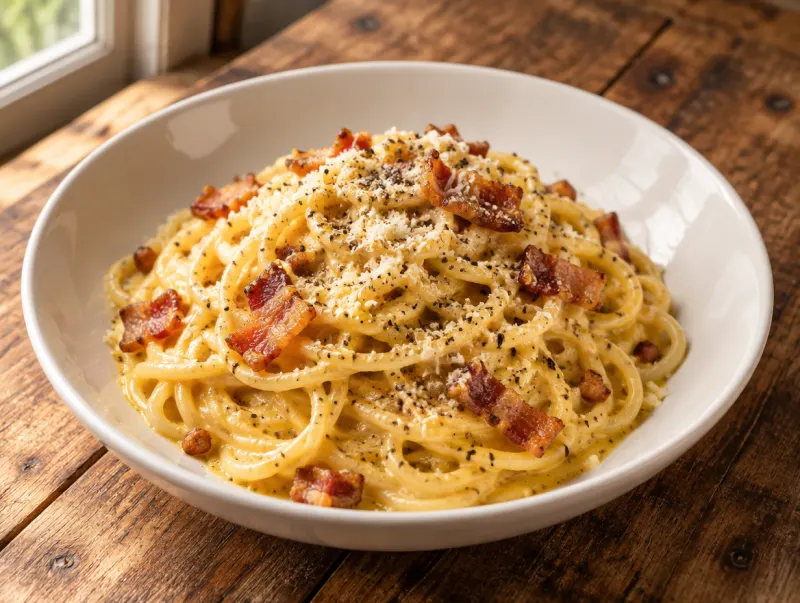
Spaghetti Carbonara Recipe: Authentic Roman Style with Guanciale
Carbonara is one of the four great pasta dishes of Rome, eaten in trattorias and homes all over the city. It has five real ingredients: pasta, guanciale, eggs, Pecorino Romano and black pepper. There is no cream, no garlic and no onion. The silky sauce comes from egg and cheese loosened with starchy pasta water.
Prep 10 min · Cook 20 min · Main
Method
- Step 1 of 8 · 10 min
Boil the water
Bring about 4 l of water to the boil in a large pot. Salt it lightly, less than you normally would, because the guanciale and pecorino are both salty and the pasta water goes into the sauce.
You needsaltguancialePecorino Romano - Step 2 of 8 · 10 min
Render the guanciale
Put the guanciale in a large cold frying pan and set it over medium-low heat. Cook, stirring now and then, until most of the fat has melted out and the strips are golden at the edges but still slightly tender, about 8 to 10 minutes. Stir in half the pepper for the last 30 seconds, then turn off the heat.
You needguanciale - Step 3 of 8
Make the egg mixture
In a bowl, whisk the egg yolks, whole eggs, grated pecorino and the rest of the pepper into a thick, smooth paste. It should look like a dense cream with no streaks of white.
You needegg yolkswhole eggsPecorino Romano - Step 4 of 8 · 9 min
Cook the spaghetti
Add the spaghetti to the boiling water and cook for 1 to 2 minutes less than the packet says, so it is still firm in the centre. It will finish cooking in the sauce. Before draining, scoop out a mug of the starchy cooking water.
You needspaghetti - Step 5 of 8
Loosen the eggs
Whisk 2 to 3 tablespoons of the hot pasta water into the egg mixture. This warms the eggs gently and thins the paste so it coats the pasta evenly instead of clumping.
You needegg yolkswhole eggs - Step 6 of 8
Toss the pasta in the fat
Lift the spaghetti straight into the frying pan with tongs, letting some water cling to it. Toss for about 1 minute so every strand is coated in the guanciale fat. The pan should be warm, not sizzling; if it is still very hot, wait 30 seconds.
You needspaghettiguanciale - Step 7 of 8
Make the sauce
Pour the egg mixture over the pasta and toss quickly and constantly with tongs, adding a splash of pasta water at a time. Within a minute the sauce should turn glossy and creamy and cling to the spaghetti. If it stays thin, set the pan over the lowest heat for a few seconds, still moving.
You needspaghettiegg yolks - Step 8 of 8
Serve straight away
Divide between warm plates, scraping every bit of sauce and guanciale from the pan. Finish with extra grated pecorino and a little more black pepper. Carbonara thickens as it sits, so eat it right away.
You needguancialePecorino Romano
About this dish
Guanciale is cured pork cheek. It renders more fat than pancetta and has a deeper, sweeter flavour, and that fat is what carries the sauce. If you cannot find it, thick-cut pancetta is the usual swap, though the taste is milder.
The only tricky part is heat. Too hot and the eggs scramble; too cool and the sauce stays runny. This method takes the pan off the heat and uses the warmth of the pasta, so the sauce turns glossy and creamy every time.
Tips
- Keep the pan off the heat when the eggs go in. The warmth of the pasta and fat is enough to thicken the sauce without scrambling it.
- Grate the pecorino very finely, on a microplane if you have one. Coarse cheese melts unevenly and makes the sauce grainy.
- Add the pasta water a little at a time. You can always loosen the sauce, but you cannot easily thicken one that is too wet.
- Use a large frying pan or a wide bowl so you have room to toss hard. Constant movement is what turns egg and cheese into a smooth sauce.
Variations
- Pancetta instead of guanciale: use the same weight of thick-cut pancetta. The sauce is a little less rich.
- Rigatoni or mezze maniche are just as common in Rome as spaghetti and hold the sauce well.
- Half pecorino, half Parmigiano Reggiano gives a milder, slightly sweeter sauce that many Roman cooks also make.
Storing and reheating
Carbonara is best eaten immediately. Leftovers keep in the fridge for 1 day in a sealed container; reheat gently in a pan with a splash of water over low heat, stirring, though the sauce will not be as silky.
What to serve with it
- A simple green salad
- Sautéed chicory or other bitter greens
- Crusty bread
Questions
Does authentic carbonara have cream?
No. Roman carbonara is made with eggs, Pecorino Romano, guanciale, pasta and black pepper. The creamy texture comes from the eggs and cheese emulsifying with the rendered fat and a little starchy pasta water, not from cream.
Can I use bacon instead of guanciale?
You can, and many people do outside Italy, but it changes the dish. Bacon is usually smoked, so the carbonara tastes smoky. Unsmoked pancetta is the closer swap. Guanciale gives the most authentic flavour and the most fat for the sauce.
How do I stop the eggs scrambling in carbonara?
Take the pan off the heat before adding the eggs, loosen the egg mixture with a little hot pasta water first, and toss constantly. If the sauce needs more heat, return the pan to the lowest flame for only a few seconds at a time.
Should I use whole eggs or only yolks?
Both work. Yolks alone give a richer, more golden sauce; whole eggs give a lighter one. This recipe uses mostly yolks with two whole eggs, a common balance in Roman home kitchens that keeps the sauce rich but not heavy.