
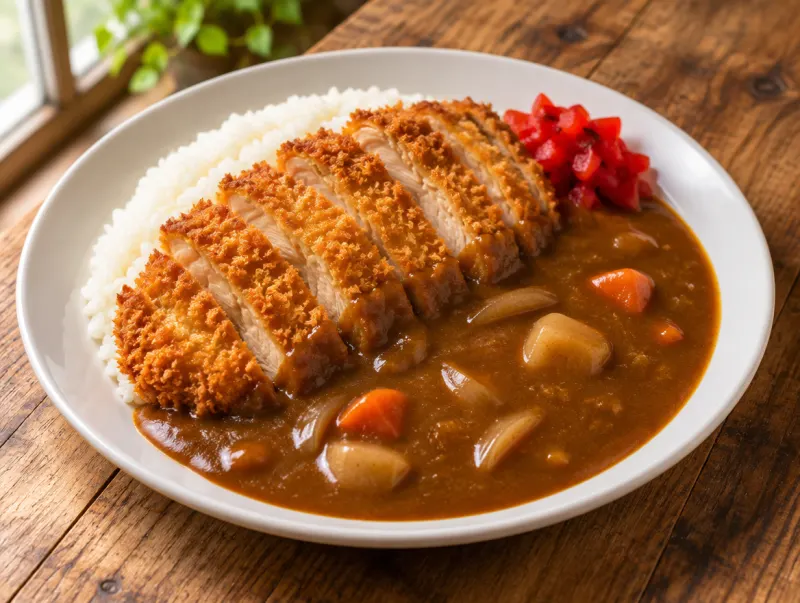
Japanese Chicken Katsu Curry Recipe from Scratch
Katsu curry is one of Japan's great comfort meals: a crisp, golden panko-crumbed cutlet sliced and laid beside a mound of rice, with a thick, glossy curry sauce poured alongside. It is a favourite in canteens, train-station curry shops and family kitchens alike.
Prep 25 min · Cook 55 min · Main
Method
- Step 1 of 9 · 25 min
Cook the rice
Rinse the rice in several changes of cold water until it runs nearly clear. Put it in a heavy pot with the 480 ml water, bring to a boil, cover and cook on the lowest heat for 15 minutes. Leave it covered off the heat for 10 minutes more.
You needJapanese short-grain ricewater - Step 2 of 9 · 15 min
Soften the onions
Heat 1 tbsp oil in a medium pot over medium heat. Add the onions with a pinch of salt and cook, stirring now and then, for about 15 minutes until soft, sweet and light golden. This slow start gives the sauce its depth.
You needonionssoy sauceneutral oilsalt and black pepper - Step 3 of 9 · 15 min
Simmer the vegetables
Stir in the garlic and ginger for 1 minute. Add the carrot, potato and chicken stock, bring to a boil and simmer, partly covered, for about 15 minutes, until the potato is tender when pierced with a knife.
You needcarrotpotatogarlicfresh gingerchicken stockskinless chicken breasts - Step 4 of 9 · 5 min
Make the roux
Meanwhile, melt the butter in a small pan over medium-low heat. Stir in 25 g flour and cook, stirring constantly, for 4 to 5 minutes until it smells toasty and turns the colour of peanut butter. Add the curry powder, stir for 30 seconds until fragrant, then take it off the heat.
You needbutterJapanese curry powderplain flour - Step 5 of 9 · 10 min
Thicken the curry
Whisk a ladle of the hot stock into the roux until smooth, then stir it back into the pot. Simmer gently for 10 minutes, stirring often, until thick and glossy enough to coat a spoon. Season with the soy sauce, honey, ketchup and salt. Keep warm.
You needchicken stockJapanese curry powdersoy saucehoneytomato ketchupsalt and black pepper - Step 6 of 9
Prepare the chicken
Slice each breast in half horizontally to make four even cutlets about 1.5 cm thick, pressing them flat with your palm. Season both sides with salt and pepper.
You needskinless chicken breastssalt and black pepper - Step 7 of 9
Bread the cutlets
Set out three plates: the remaining flour, the beaten eggs and the panko. Coat each cutlet in flour and shake off the excess, dip it in egg, then press it firmly into the panko on both sides so the crumbs stick in a thick, even layer.
You needplain floureggspanko breadcrumbs - Step 8 of 9 · 8 min
Fry the katsu
Heat the oil in a large frying pan, about 1.5 cm deep, to 170°C; a crumb should sizzle steadily straight away. Fry two cutlets at a time for 3 to 4 minutes a side, until deep golden and cooked through to 74°C in the centre.
You needneutral oil - Step 9 of 9
Rest, slice and serve
Drain the katsu on a wire rack for 3 minutes so the crust stays crisp, then slice into 2 cm strips. Spoon rice onto one side of each plate, lay the katsu against it and pour the curry beside it, not over the top, so the crumb stays crunchy.
You needJapanese curry powderJapanese short-grain rice
About this dish
Japanese curry is nothing like an Indian curry. It arrived in Japan by way of Britain and grew into its own dish: mild, slightly sweet, and thickened with a roux of butter and flour, closer to a rich gravy than a spiced stew. Most homes use boxed curry blocks, but a roux made from scratch takes only five minutes and tastes fresher.
This version uses chicken breast cutlets shallow-fried in an ordinary frying pan, so you do not need a deep fryer. The curry sauce simmers while you bread the chicken, and everything comes together in about an hour, with the rice cooking alongside.
Tips
- Rest fried katsu on a rack rather than paper towels; trapped steam makes the underside soggy.
- Use a thermometer for the oil if you have one. Too cool and the panko soaks up oil, too hot and it burns before the chicken cooks.
- Grate in half an apple with the stock for the gentle fruity sweetness many Japanese home cooks add.
- The curry tastes even better the next day, so make the sauce ahead and fry the katsu fresh.
Variations
- With curry blocks: skip the roux, simmer the vegetables in 700 ml water, then melt in half a 200 g box of Japanese curry roux off the heat and simmer 5 minutes.
- Tonkatsu curry: use 4 pork loin chops, 1.5 cm thick, and fry for 4 to 5 minutes a side.
- Air fryer katsu: spray the breaded cutlets with oil and air fry at 200°C for 12 to 15 minutes, turning once.
Storing and reheating
The curry sauce keeps 4 days in the fridge or 3 months frozen (freeze it without the potato, which turns grainy). Katsu keeps 2 days; reheat on a rack in a 200°C oven for 10 minutes to re-crisp.
What to serve with it
- Japanese short-grain rice
- Fukujinzuke (red pickled vegetables)
- Shredded white cabbage
- Miso soup
Questions
What is the difference between katsu curry and Japanese curry?
Japanese curry, or karē raisu, is the curry sauce served with rice. Katsu curry is the same dish topped with a breaded, fried cutlet, usually pork or chicken. The sauce is the same in both.
Is chicken katsu curry spicy?
No. Japanese curry is mild and slightly sweet. For more heat, add a pinch of cayenne or a hotter curry powder to the roux, or use a medium or hot curry block.
Can I use Golden Curry or other curry cubes?
Yes, that is how most Japanese homes make it. Simmer the vegetables in water instead of stock, take the pot off the heat, melt in the cubes and simmer for 5 minutes until thick.
Should I use chicken breast or thigh for katsu?
Both work. Breast gives the classic clean, even slices; boneless thigh is juicier and more forgiving. Flatten thighs to an even 1.5 cm and fry them for the same time.