
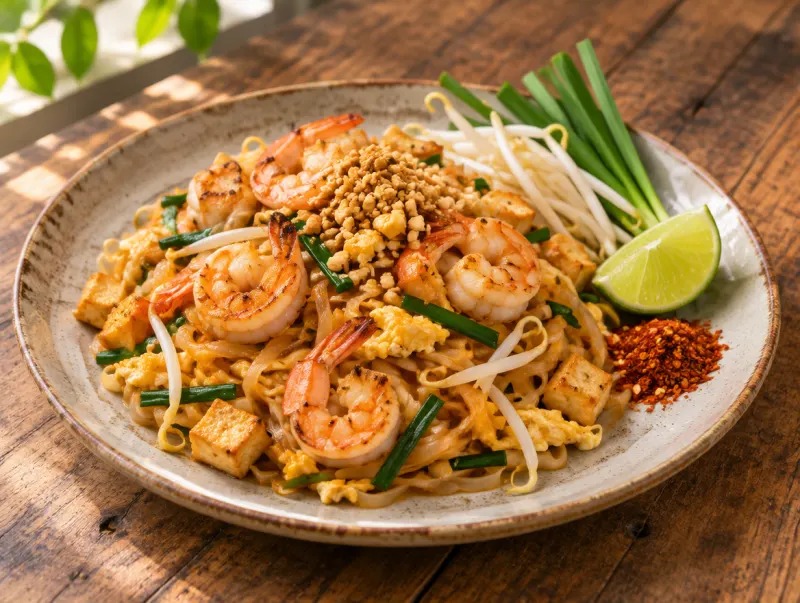
Authentic Pad Thai Recipe with Tamarind Sauce
Pad thai, phat Thai in Thai, is the stir-fried rice noodle dish sold from street carts and night-market woks all over Thailand. Soft, chewy noodles are tossed with shrimp, tofu, egg and garlic chives in a sauce that is sour, sweet and salty at once, then finished at the table with lime, chilli and crushed peanuts.
Prep 45 min · Cook 10 min · Main
Method
- Step 1 of 9 · 30 min
Soak the noodles
Cover the noodles with lukewarm water and soak for about 30 minutes, until they are white, limp and bend easily but still feel firm in the centre. Drain well. They finish softening in the wok, so do not boil them.
You needdried flat rice noodleswater - Step 2 of 9 · 3 min
Make the sauce
Put the tamarind, fish sauce and palm sugar in a small pan over low heat and stir for 2 to 3 minutes, just until the sugar melts. Taste: it should be sour, sweet and salty in roughly equal measure. Add a little more sugar or tamarind to balance.
You needtamarind pastefish saucepalm sugar - Step 3 of 9
Get everything ready
Pad thai cooks in minutes, so set every ingredient beside the stove before you start: drained noodles, sauce, shrimp, tofu, shallots, garlic, radish, dried shrimp, eggs, a cup with the water, sprouts and chives.
You needfish saucedried flat rice noodlesraw shrimpfirm tofushallotsgarlicpreserved sweet radishsmall dried shrimpeggs - Step 4 of 9
Cook the shrimp
Heat a wok over high heat until it smokes lightly. Add 1 tbsp oil and the shrimp and stir-fry for 1 to 2 minutes, until they just turn pink and curl. Tip them onto a plate.
You needneutral oilraw shrimpsmall dried shrimp - Step 5 of 9
Fry the tofu and aromatics
Add the remaining 2 tbsp oil and the tofu and fry for about 2 minutes, until golden at the edges. Add the shallots, garlic, preserved radish and dried shrimp and stir for 30 seconds, until fragrant but not browned.
You needneutral oilraw shrimpfirm tofushallotsgarlicpreserved sweet radishsmall dried shrimpgarlic chives - Step 6 of 9 · 3 min
Add noodles and sauce
Add the noodles and 2 tbsp water and toss for 1 minute. Pour in the sauce and keep tossing for 2 to 3 minutes until the noodles absorb it and turn soft and chewy. If they are still firm and the wok is dry, add the remaining water a spoonful at a time.
You needfish saucedried flat rice noodleswater - Step 7 of 9
Scramble the eggs
Push the noodles to one side of the wok. Crack the eggs into the empty space and leave for 20 to 30 seconds until they start to set, then break them up and fold them through the noodles.
You needdried flat rice noodleseggs - Step 8 of 9
Finish
Return the shrimp with half the bean sprouts, the garlic chives and half the peanuts. Toss for about 30 seconds, just until the chives wilt and the sprouts are warm but still crunchy.
You needraw shrimpgarlicsmall dried shrimpbean sproutsgarlic chivesroasted peanuts - Step 9 of 9
Serve
Pile onto plates with the remaining raw bean sprouts, peanuts, lime wedges and chilli flakes on the side. In Thailand everyone adjusts their own plate with a squeeze of lime, a pinch of chilli and sometimes a little extra sugar.
You needpalm sugarbean sproutsroasted peanutslimedried chilli flakes
About this dish
The flavour comes from three things: tamarind for sourness, palm sugar for a round caramel sweetness and fish sauce for salt. There is no ketchup or peanut butter in the classic version. Preserved sweet radish and dried shrimp add the savoury depth you taste in good street-stall pad thai.
Cook two portions at a time. A crowded wok steams the noodles instead of frying them, and they turn soggy. Have every ingredient chopped and lined up before you light the stove, because once the noodles go in, the whole dish is done in about five minutes.
Tips
- Soak, never boil, the noodles. Boiled noodles break and turn gummy in the wok.
- If your tamarind is a block with seeds, soak 40 g in 120 ml hot water for 10 minutes, squeeze, and strain to make the paste.
- Keep the heat high and the batch small: two portions per wok gives the slightly smoky, dry-fried texture you want.
- Make a jar of the sauce ahead; it keeps for 2 weeks in the fridge.
Variations
- Chicken pad thai: use 200 g thinly sliced chicken thigh instead of shrimp and cook it for 3 to 4 minutes before adding the tofu.
- Vegetarian pad thai: skip the shrimp and dried shrimp, double the tofu and use light soy sauce in place of fish sauce.
- Pad thai wrapped in a thin omelette (phat Thai ho khai) is a popular street-stall version.
Storing and reheating
Best eaten straight from the wok. Leftovers keep 1 day in the fridge; reheat in a hot pan with a splash of water, tossing until steaming.
What to serve with it
- Lime wedges and dried chilli flakes
- Raw bean sprouts and garlic chives
- Banana blossom or cucumber slices
- Thai iced tea
Questions
What is pad thai sauce made of?
Authentic pad thai sauce is tamarind, fish sauce and palm sugar, warmed together until the sugar melts. Some cooks add a little vinegar or chilli. Ketchup, soy sauce and peanut butter are not part of the classic version.
Can I make pad thai without tamarind?
You can mix 2 tbsp lime juice with 1 tbsp rice vinegar as the sour element. It tastes brighter and less fruity than tamarind, but still makes a good plate of noodles.
Why are my pad thai noodles mushy?
They were soaked in water that was too hot, boiled, or cooked in too large a batch. Soak in lukewarm water until just pliable, cook two portions at a time and keep the wok very hot.
Is pad thai gluten-free?
Made this way with rice noodles, fish sauce and tamarind, yes. Check the labels on your fish sauce and preserved radish, as a few brands add wheat-based ingredients.