
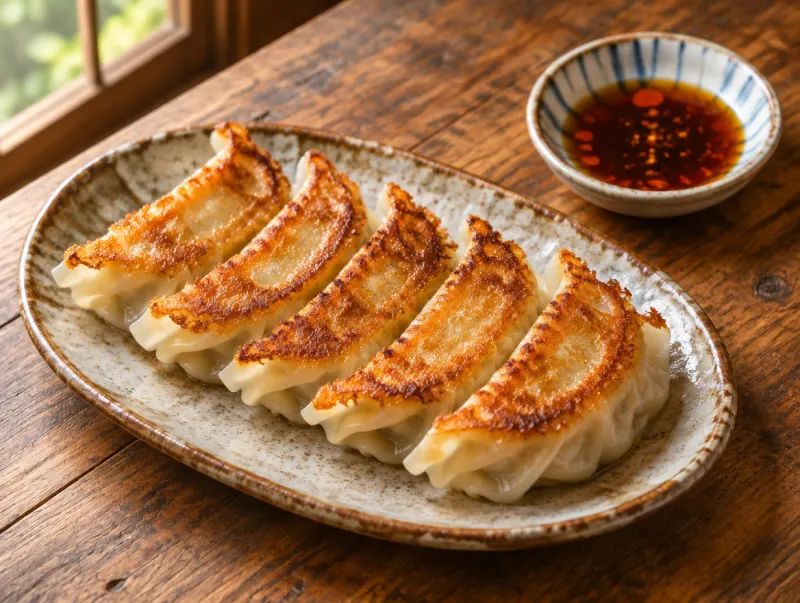
Japanese Pork Gyoza Recipe: Crispy Pan-Fried Dumplings
Gyoza are Japan's take on Chinese jiaozi: small, thin-skinned dumplings filled with juicy pork, cabbage, garlic and garlic chives. In Japan they are almost always eaten as yaki gyōza, pan-fried so the bottoms turn crisp and golden while the tops steam soft, and they are a classic partner to a bowl of ramen or a cold beer.
Prep 45 min · Cook 20 min · Snack
Method
- Step 1 of 9 · 15 min
Salt the cabbage
Toss the chopped cabbage with 1 tsp salt in a bowl and leave for 15 minutes. Gather it in a clean tea towel or your hands and squeeze hard until no more water runs out. Squeezed cabbage keeps the filling from turning watery and the wrappers from going soggy.
You neednapa cabbagesaltround gyoza wrapperswater - Step 2 of 9
Make the filling
In a large bowl, combine the pork, 1 tbsp soy sauce, the sake, 1 tbsp sesame oil, sugar, white pepper, garlic and ginger. Mix vigorously with your hand for 1 to 2 minutes until the meat turns sticky and paste-like. Fold in the cabbage and garlic chives.
You neednapa cabbageminced porkgarlic chivesgarlicfresh gingersakesoy saucetoasted sesame oilsugar - Step 3 of 9
Fold the gyoza
Hold a wrapper in your palm and put a heaped teaspoon of filling in the centre. Wet half the edge with water, fold it over and, starting at one end, make five or six small pleats along the front edge, pressing each against the flat back to seal.
You needround gyoza wrapperswater - Step 4 of 9
Keep them ready
Set each gyoza on a tray lined with baking paper, sitting upright on its flat base, and cover with a damp cloth so the wrappers do not dry out while you fold the rest. You should have about 40.
You needround gyoza wrappers - Step 5 of 9 · 3 min
Fry the bottoms
Heat 1 tbsp neutral oil in a 26 cm non-stick frying pan with a lid over medium-high heat. Arrange about 20 gyoza flat side down in tight rows or a circle. Fry for 2 to 3 minutes, until the bottoms are golden brown.
You needtoasted sesame oilneutral oilchilli oil - Step 6 of 9 · 5 min
Steam them through
Pour 60 ml water into the pan, standing back as it spits, and cover at once. Turn the heat to medium and steam for 4 to 5 minutes, until the wrappers look translucent and most of the water has gone.
You needround gyoza wrapperswater - Step 7 of 9
Crisp again
Remove the lid and cook for 1 to 2 minutes more until the last of the water evaporates and the bottoms crackle. Drizzle half the remaining sesame oil around the edge of the pan and cook for 30 seconds.
You needtoasted sesame oilneutral oilwaterchilli oil - Step 8 of 9
Turn out and repeat
Place a plate upside down over the pan and flip the gyoza out so the crisp bottoms face up. Repeat with the second batch, wiping the pan first.
- Step 9 of 9
Make the dip and serve
Stir together the remaining 3 tbsp soy sauce, the rice vinegar and the chilli oil in small dishes. Serve the gyoza hot from the pan, dipping the crisp side into the sauce.
You needsoy saucetoasted sesame oilneutral oilrice vinegarchilli oil
About this dish
The method is simple and clever. You fry the dumplings in a little oil, add water and cover the pan to steam them through, then let the water cook away so the bottoms crisp again. One pan gives you two textures, tender and crunchy, in about ten minutes.
Folding takes a few tries, but you will have the hang of it by the tenth one, and uneven pleats taste just as good. Shop-bought wrappers are what most Japanese home cooks use, and they work perfectly. Make a double batch and freeze half for quick dinners.
Tips
- Mixing the pork until sticky is what gives gyoza a bouncy, juicy filling that does not crumble.
- Do not overfill. A heaped teaspoon is enough for a 9 cm wrapper and makes pleating much easier.
- For a lacy crisp skirt (hanetsuki), stir 1 tsp plain flour into the steaming water.
- Fry the first one alone to taste the filling and adjust the seasoning before folding the rest.
Variations
- Chicken gyoza: use minced chicken thigh in place of pork.
- Vegetable gyoza: replace the pork with 200 g finely chopped shiitake and 150 g crumbled firm tofu, squeezed dry.
- Sui gyōza: boil the dumplings in simmering water for 4 to 5 minutes until they float and serve them in a light broth.
Storing and reheating
Freeze uncooked gyoza on a lined tray until hard, then bag them; they keep 2 months. Cook from frozen exactly as above, steaming 2 minutes longer. Cooked gyoza keep 2 days in the fridge; re-crisp in a hot pan.
What to serve with it
- Soy-vinegar dipping sauce with chilli oil
- Ramen
- Steamed rice and miso soup
- Cold beer or green tea
Questions
What is the difference between gyoza and dumplings?
Gyoza are a Japanese style of dumpling that came from Chinese jiaozi. They usually have thinner wrappers, a finer, more garlicky filling and are mostly pan-fried to a crisp base rather than boiled.
Why do my gyoza stick to the pan?
The pan was not non-stick or not hot enough, or the water was not fully cooked off. Use a good non-stick pan, enough oil, and let the bottoms crisp again before turning them out.
Can I make gyoza without cabbage?
Yes. Use finely chopped garlic chives, spring onions or bok choy instead, salted and squeezed the same way, or simply use more pork with a spoonful of water mixed in to keep it juicy.
Can I cook gyoza from frozen?
Yes, do not thaw them. Fry the frozen gyoza as normal, add the water, and steam with the lid on for 6 to 7 minutes before uncovering to crisp the bottoms.