

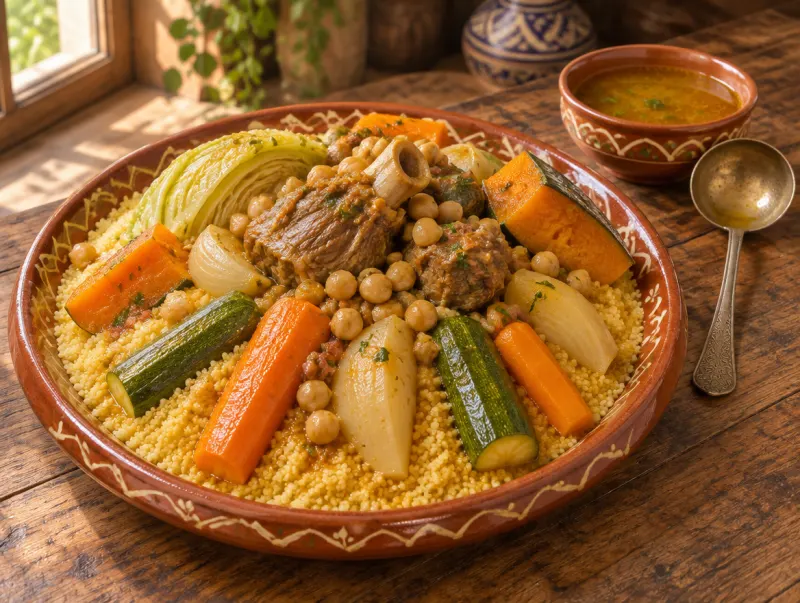
Moroccan Couscous Recipe with Seven Vegetables and Lamb
 Morocco
Couscous is the Friday meal across Morocco. After midday prayers, families gather around one large dish of steamed couscous piled with meat and vegetables and moistened with broth, and everyone eats from the section in front of them. The best known version is couscous with seven vegetables, often called couscous bidaoui after Casablanca.
Prep 30 min · Cook 1 h 40 · Main
Method
- Step 1 of 11 · 10 min
Start the broth
In the base of a couscoussier or a large deep pot, heat 3 tablespoons of olive oil over medium heat. Add the lamb shoulder, the chopped onion, grated tomatoes, salt, black pepper, ground ginger and turmeric. Cook for 10 minutes, turning the meat, until it has lost its raw colour and the onion and tomato have turned into a thick sauce.
You needlamb shoulderonionsripe tomatoesolive oilsaltground black pepperground gingerground turmericolive oil - Step 2 of 11 · 30 min
Add water and simmer
Pour in the 2.5 litres of water, add the tied bunch of coriander and parsley and bring to a boil. Lower the heat, cover and simmer for 30 minutes while you prepare the couscous.
You needsmall bunch of fresh coriander and parsleywatermedium couscouscold water - Step 3 of 11 · 10 min
Moisten the couscous
Tip the couscous into a very wide dish. Rub in 2 tablespoons of olive oil with your palms until every grain is coated. Sprinkle over about 250 ml of the salted cold water, a little at a time, raking with your fingers so it is absorbed evenly. Leave it to swell for 10 minutes.
You needolive oilwatermedium couscousolive oilcold water - Step 4 of 11 · 15 min
First steaming
Put the couscous loosely into the steamer basket, without pressing, and set it over the simmering broth. Leave it uncovered. Once you see steam rising through the couscous, steam for 15 minutes.
You needmedium couscous - Step 5 of 11
Add the firm vegetables
Lift off the basket and tip the couscous back into the wide dish. Add the carrots, turnips, cabbage wedge and onion wedges to the broth and bring it back to a simmer.
You needonionscarrotssmall turnipswhite cabbagemedium couscous - Step 6 of 11 · 15 min
Second steaming
Break up the hot couscous with a fork, then sprinkle over another 250 ml of the salted water and rake it through with your fingers until there are no lumps. Return the couscous to the basket and steam over the broth for 15 minutes once steam rises through it.
You needwatermedium couscouscold water - Step 7 of 11
Add the soft vegetables
Tip the couscous back into the dish. Add the pumpkin, zucchini and chickpeas to the broth, pushing them gently under the liquid. Top up with a cup of hot water if the vegetables are not almost covered.
You needwaterpumpkin or butternut squashzucchinichickpeasmedium couscouscold water - Step 8 of 11 · 15 min
Third steaming
Work the remaining 150 ml of salted water into the couscous, breaking up any lumps. Return it to the basket and steam a final 15 minutes. The grains should be tender, light and separate, with no hard centre.
You needwatermedium couscouscold water - Step 9 of 11
Butter the couscous
Tip the couscous into the dish one last time. Add the butter in small pieces and toss it through with a fork until it melts and the grains are glossy. Taste and add a pinch of salt if it needs it.
You needsaltmedium couscousbutter - Step 10 of 11
Check the broth
The lamb should pull away from the bone easily and a knife should slide through the carrots and turnips. If not, simmer for 10 to 15 minutes more. Taste the broth and adjust the salt. Lift out and discard the bunch of coriander and parsley.
You needlamb shouldersaltsmall bunch of fresh coriander and parsleycarrotssmall turnips - Step 11 of 11
Assemble and serve
Mound the couscous on a large round serving dish and make a wide well in the centre. Put the lamb in the well and arrange the carrots, turnips, cabbage, pumpkin, zucchini, onion and chickpeas over and around it. Ladle a few spoons of broth over everything and serve the rest of the broth in a bowl at the table.
You needlamb shoulderonionscarrotssmall turnipswhite cabbagepumpkin or butternut squashzucchinichickpeasmedium couscous
About this dish
The dish is cooked in two layers. In the bottom pot, lamb simmers with onion, tomato, ginger and turmeric, and the vegetables go in by how long they take: carrots, turnips and cabbage first, pumpkin and zucchini later. Above it, the couscous steams in the rising vapour, so it takes on the smell of the broth.
What makes this version work is steaming the couscous three times instead of soaking it in hot water. Between each steaming you rub it with a little water and break up the lumps. It takes longer than the packet method, but the grains come out light, separate and almost twice the size.
Tips
- No couscoussier? Set a metal steamer or a colander lined with a thin clean cloth over a deep pot. If steam escapes around the rim, wrap a damp tea towel around the join so it is forced up through the couscous.
- Never cover the couscous while it steams and never pack it down. Loose grains with room to swell are what make it light.
- Keep the vegetables in large pieces. Small cubes break up in the broth, and big halves look right on the dish.
- Leave the skin on the pumpkin while it cooks. It holds the chunks together, and it comes away easily on the plate.
- Add broth at the table, not all at once. Each person moistens their own portion so the couscous never turns soggy.
Variations
- With chicken or beef: use a whole chicken cut into pieces and add the firm vegetables after 15 minutes, or use beef shank and simmer it 30 minutes longer before the vegetables go in.
- With tfaya: top the dish with onions slowly cooked with raisins, cinnamon and a little honey until soft and caramelised. It is a favourite sweet topping in many Moroccan homes.
- Vegetarian: leave out the lamb, start the broth with the onion, tomato and spices, and add extra chickpeas. Finish the couscous with olive oil instead of butter for a vegan dish.
- Quick weeknight couscous: if time is short, prepare instant couscous as the packet says and fluff it with butter. The broth and vegetables are made the same way.
Storing and reheating
Store the couscous and the lamb, vegetables and broth in separate covered containers in the fridge for up to 3 days. Reheat the broth, meat and vegetables in a pot until simmering, and re-steam the couscous for 10 minutes or warm it in a covered dish with a splash of broth. The broth and lamb freeze well for up to 3 months; the vegetables turn soft after freezing.
What to serve with it
- A bowl of the hot broth for ladling over
- Harissa or a fresh chili simmered in the broth
- Lben, Moroccan buttermilk, or plain cold buttermilk
- Fresh fruit and mint tea afterwards
Questions
What is Moroccan couscous made of?
The couscous itself is tiny granules of durum wheat semolina. In Morocco it is steamed and served with a stew of lamb, beef or chicken, vegetables such as carrots, turnips, cabbage, pumpkin and zucchini, chickpeas, and a broth seasoned with ginger, turmeric and pepper.
Why is couscous steamed three times?
Each steaming lets the grains absorb a little more water and swell without turning sticky. Rubbing them between steamings breaks up lumps. The result is much lighter and fluffier than couscous that has only been soaked in hot water.
Can I make Moroccan couscous without a couscoussier?
Yes. Use a metal steamer basket or a colander that sits snugly over a deep pot, lined with a thin cloth if the holes are large. Seal the join with a damp tea towel so the steam travels up through the couscous.
What are the seven vegetables in Moroccan couscous?
There is no fixed list, and cooks use what is in season. Common choices are onion, tomato, carrot, turnip, cabbage, pumpkin and zucchini. Chickpeas are almost always added, and some families include fava beans, sweet potato or a chili pepper.
Is couscous a grain or a pasta?
It is closer to pasta. Couscous is made by rolling moistened durum wheat semolina into small granules, which are then dried. It is not a whole grain picked from a plant, and it contains gluten.
 Tunisia
 Nigeria